What is a half-space, and why do coaches want players there?
At Euro 2024, players who received the ball in a half-space had nearly twice as much chance of being free as in the centre, and set up or took a shot three times as often as on the wing.
Draw two lines down the pitch along the edges of each penalty area, and two more along the edges of each six-yard box. You now have five lanes: a wing on each side, the centre, and between them the two half-spaces.
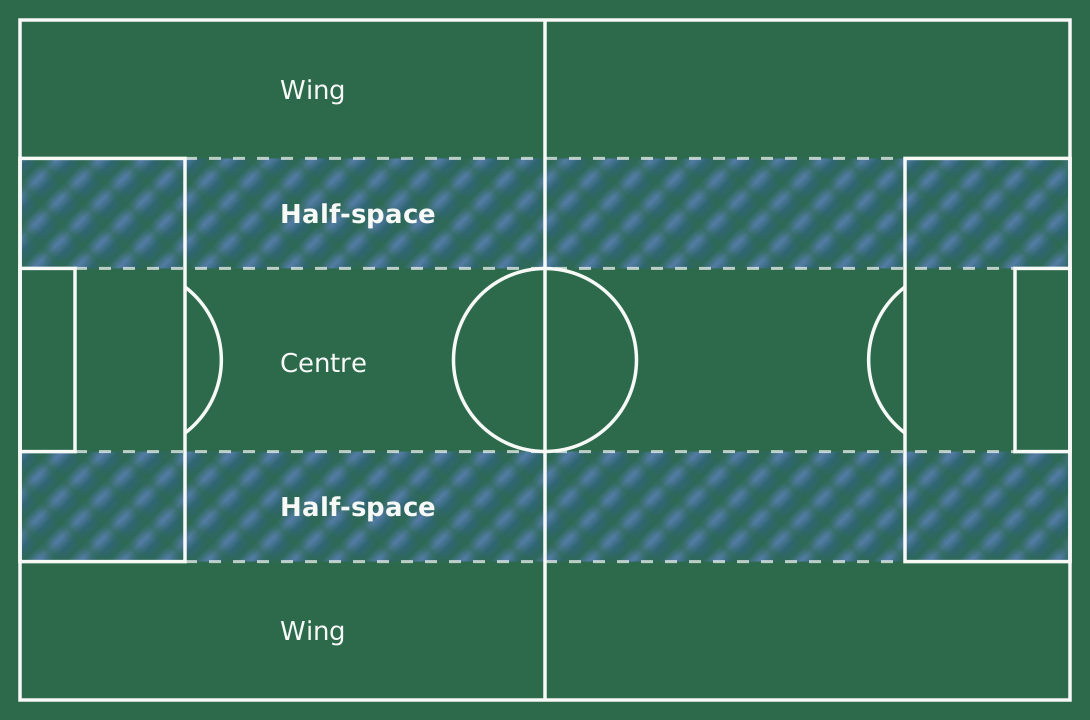
Coaches have talked about these lanes for years, and this site is named after them. This piece is the first in a series that uses StatsBomb’s 360 data to test tactical ideas, and it starts with the obvious question: is the half-space really a better place to get the ball?
Why the in-between lane matters
A player on the wing has the touchline on one side, so half the options are gone. A player in the centre can pass anywhere, but the centre is where defenders gather.
The half-space sits between the two. From there a player can still pass inside, outside, forward and back, usually with fewer opponents close by. Being at an angle to goal, a receiver there faces the play diagonally and can see both the box and the flank without turning.
That is the theory. Event data alone cannot test it, because it records where the ball was but not where anyone else stood. 360 data can.
What 360 data adds
For most events in a match, StatsBomb’s 360 data adds a freeze frame: a snapshot of where every player in the broadcast picture was standing at that moment. At Euro 2024, 91% of the 45,338 completed receptions in the tournament’s 51 matches came with one.
That lets us ask a question about every pass received: how close was the nearest opponent? We call a reception free when no opponent was within five metres of the receiver.
There are limits, and they matter. The players in a freeze frame are anonymous: we know the receiver’s name from the event, but the others are only marked as teammate, opponent or goalkeeper. Only players inside the camera’s view are included, on average 8.5 of the 11 opponents. And each frame is a single snapshot, not continuous tracking, so it shows where an opponent was, not how fast they were closing in. To avoid counting a player as free when the nearest opponent was simply out of shot, space is only measured when the camera saw the full five metres around the receiver.
34%Final-third half-space receptions that were free. Centre: 19%
16%Half-space receptions followed by a shot or the pass before one. Wing: 5%
3.8 mTypical gap to the nearest opponent in a final-third half-space
20%Half-space receptions between the lines that were free
Trading space for danger
In the final third, the three lanes trade space for danger in a straight line.

The wing is where the room is. Just over half of final-third receptions there were free, and the typical gap to the nearest opponent was 5.1 metres. But receivers on the wing took a shot or played the pass before one only 5% of the time.
The centre is the opposite. It is the most dangerous place to have the ball, with 35% of receptions followed straight away by a shot or a shot assist, but only 19% of them were free and the typical gap was 2.7 metres. Part of that danger is simply location: a third of central receptions in the final third were inside the box.
The half-space sits in between on both counts: 34% free, a typical gap of 3.8 metres, and 16% of receptions turned straight into a shot or the pass before one. That is more than three times the wing’s rate, with nearly twice the centre’s chance of finding room. Space helped there, too. Free half-space receivers went on to shoot or set up a shot 18.5% of the time, against 15.3% for those with an opponent close by.
The half-space offers nearly twice the centre's chance of finding room, and more than three times the wing's threat.
Between the lines
The most prized version of a half-space reception is one between the lines: behind the opposition’s midfield but in front of its defence. Here we count a reception as between the lines when it comes in the opposition half but outside the box, with at least three visible outfield opponents behind the receiver and at least three still goal-side.
This is where defences squeeze hardest. In the half-spaces of the opposition half, receptions that were not between the lines were free 62% of the time. Between the lines, that fell to 20%, and the typical gap to the nearest opponent shrank from 5.9 metres to 3.1.
So when it does happen, it looks like this. In the 12th minute of Spain’s group match against Albania, Aymeric Laporte played a diagonal pass from just inside Spain’s half to Dani Olmo in the right half-space. Six visible Albania outfield players were behind Olmo and four were still goal-side, but the nearest was 5.7 metres away. Olmo had time to run with the ball and slide a 19-metre through ball to Ferran Torres, who scored the only goal of the match.

Who lived there
The players who received most often in the half-spaces between the lines were the creative midfielders everyone would expect, led by Germany’s pair of No. 10s.

Florian Wirtz received the ball in a half-space between the lines 6.8 times per 90 minutes, and Jamal Musiala 6.1 times. With İlkay Gündoğan also in the top ten, Germany did it more than any other side: 25.0 times per match, ahead of Denmark (22.8) and Spain (21.6). Albania managed 6.3.
Pedri received there 10.5 times per 90 minutes for Spain, a higher rate than anyone on the chart, but played only 189 minutes before being injured in the seventh minute of the quarter-final against Germany, so falls below the cut-off. Olmo, who came on for Pedri that night, is fourth on the list.
What to watch for
- Free eights and inside forwards drifting into the half-space between the opposition’s full-back and centre-back.
- Diagonal passes from centre-backs that skip the midfield, like Laporte’s to Olmo.
- Overlaps and underlaps: a full-back running outside or inside a teammate who holds the half-space.
- Cut-backs: low passes from the edge of the six-yard box, which is the inside edge of the half-space.
What the data cannot tell us
Three caveats. First, a freeze frame is one moment. A receiver with five metres of room and a defender sprinting towards them is less free than the number suggests. Second, the camera follows the ball, so receptions near the touchline are more often cut off at the edge of the picture. That is why only about half the wing receptions in the final third could be measured for space. Third, “between the lines” here is a rule of thumb built from the players the camera could see, not a tracking of each team’s actual defensive shape.
Next in the series: what expected goals can and cannot see, using the shots and freeze frames from the Euro 2024 final.
Method and data
StatsBomb Open Data with 360 freeze frames for all 51 matches of Euro 2024 (competition 55, season 282). Extra time is included; penalty shoot-outs are not. A reception is a completed Ball Receipt event. Lanes follow the pitch markings in StatsBomb's 120 × 80 coordinates: wings outside the penalty-area edges (y below 18 or above 62), half-spaces between the penalty-area and six-yard-box edges, and the centre inside the six-yard-box edges (y 30 to 50). The final third is x of 80 or more. Distances are converted to metres on a 105 × 68 m pitch. Space (free receptions and the median gap to the nearest opponent, goalkeeper included) is measured only when the receiver was at least 5 m inside the camera's visible area, which keeps 29,268 of the 41,038 receptions with a frame. "Next action" is the receiver's next pass, shot, dribble, miscontrol, dispossession or foul won in the same possession, following any carry; a shot or a pass StatsBomb marks as a shot assist or goal assist counts. Between the lines: x from 60 to below 102, with at least three visible outfield opponents nearer the receiver's own goal and at least three nearer the goal being attacked. Minutes come from line-ups, substitutions and red cards. All figures were computed in code (charts/half_space_360.py) from the data. Data: StatsBomb.